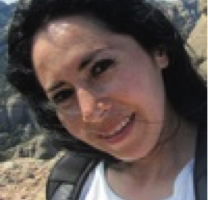
EGU Soloviev Medal 2016 to IRASEMA ALCÁNTARA-AYALA
The EGU 2016 Sergey Soloviev Medal is awarded to Irasema Alcántara-Ayala for her outstanding contribution to the basic knowledge of natural hazards, vulnerability and prevention of disasters in developing countries.
From the EGU medals 2016 webpage:
“Irasema Alcántara-Ayala is an outstanding expert in natural hazard and risk assessment, with knowledge spanning from mass movement processes, landslide occurrences and hazards to vulnerability, disaster risks and prevention of disasters. Alcántara-Ayala’s research has consistently been of very high quality. Her paper ‘Geomorphology, natural hazards, vulnerability and prevention of natural disasters in developing countries’ is one of the influential articles in the field, being widely cited and extensively used by the scientific community and decision makers. Her research distinguished itself by the degree to which it combines theoretical and intensive field investigations with state-of-the-art science and technology, such as landslide instrumentation and monitoring, geographic information systems and satellite imagery. What makes Alcántara-Ayala internationally recognised, and one of a few truly unique scholars in this field, is her ability to combine natural science with social science approaches, using, among other things, the analysis of social vulnerability and integrated research methods on disaster risk to help in understanding the generic and specific impact of physical hazards on society. Her efforts have not only improved our understanding of natural hazards from a natural scientific point of view, but also raised social awareness about the importance and the need for implementing disaster risk reduction strategies based on the understanding of root causes. In an era of recognised global environmental change, it is essential that the science of disaster risk is comprehensively understood and undertaken, and this can only be done through interdisciplinary and integrated approaches, such as those represented by Alcántara-Ayala’s research. She has closely collaborated with the National Centre for Disasters Prevention in Mexico, and published several bulletins and reports addressing, among other aspects, natural hazards and the significance of educating and promoting the culture of prevention. She has led a very distinguished career. She got her BSc degree in geography from the National Autonomous University of Mexico (UNAM), obtained her PhD in geography/geomorphology from King’s College London (UK), and spent her postdoctoral years in the Department of Civil and Environmental Engineering at MIT (USA). In 2000, she was selected as an assistant professor at the Institute of Geography at UNAM, was promoted to full professor a few years later, and appointed as director in 2008, becoming the youngest female director in the institute’s history. Of particular organisational and social significance are her election to, and enthusiastic participation in, leading international organisations, including the International Association of Geomorphologists, International Consortium of Landslides, International Geographical Union, the Integrated Research on Disaster Risk programme co-sponsored by the International Council for Science, the International Social Sciences Council, and the United Nations Office for Disaster Risk Reduction. Alcantara-Ayala’s academic activities in terms of natural hazards and disaster risk reduction are of great significance not only for geosciences, but also for the wellbeing of societies, especially in the developing world.”
