IAG Photo & Video Contest – Overall Winners 2025

In accordance with the rules of the IAG Photo & Video Contest, the IAG Selection Committee voted to select the Overall Winners of 2025 – for both the Photo and the Video Contest! Congratulations to both of them! Find their contributions below.

The Overall Winners in 2025 are:


Ventifacts – aeolian rocky geomorphic features
by Špela Čonč, Slovenia

Death Valley National Park in the USA is often described as a land of extremes, known for being the hottest, driest, and lowest national park. While deserts may seem like barren, monotonous landscapes, they are shaped by a variety of physical and anthropogenic factors—Death Valley being no exception. Despite its harsh conditions, the park boasts remarkable biodiversity and geodiversity. Beyond its famous landmarks, such as Badwater Basin, Devil’s Golf Course, and Zabriskie Point, Death Valley also features smaller-scale geomorphic wonders. Among them are ventifacts — rocks sculpted by wind-driven sand into abraded, pitted, etched, grooved, or polished forms. These features typically develop in valley bottoms and open areas where strong winds transport sand and silt over long distances, effectively sandblasting the rock surfaces. If undisturbed, ancient ventifacts serve as valuable paleo-wind indicators, as their grooves and striations align with historical wind directions.


Bank Erosion and River Merging: The Bhagirathi-Babla Confluence Shift, West Bengal, India
by Sayantan Das, India

The Bhagirathi and Babla Rivers in the Ganga Delta, West Bengal, India, have undergone significant morphological changes due to lateral erosion. Persistent bank erosion — on the right bank of Bhagirathi and the left bank of Babla — led to the eventual merging of their channels. This confluence shift, occurring 4.5 km upstream from the original junction, resulted in the isolation of Nutangram village from the mainland. The process culminated in October 2021, during the late monsoon, when continuous bank failure triggered the final breach. The hydrodynamic forces, coupled with seasonal high flows, facilitated this channel adjustment. Such geomorphological changes highlight the dynamic nature of river systems in the Ganga Delta, emphasizing the role of monsoonal discharge and sediment transport in modifying river courses.

IAG Video Contest – winner October-December 2025

The winner of the IAG Video Contest for the period October-December 2025 is Rosa Colacicco (Italy)! Find below her video and descriptive text.

If you want to participate in the contest, find the rules, guidelines and details on the procedure here.


RivAIr: Real-Time River Monitoring System for Climate Resilience

by Rosa Colacicco, Italy

Despite major advances in Earth Observation (EO), real-time observation of river flood propagation remains limited. Satellites provide valuable but infrequent snapshots of inundation, while surface flow kinematics, the key drivers of flood energy, sediment transport, and channel reshaping, are often inferred from models rather than directly observed.
RivAIr bridges this gap through a drone-based edge computing platform for real-time hydrodynamic observation. Designed as a fully autonomous sensing node integrable within drone-in-a-box infrastructure, RivAIr uses Convolutional Neural Networks and optical flow algorithms to map river water extent and surface velocity fields on board and in real time. These measurements can reveal sudden geomorphological changes that shape flood hazard levels, eliminating ground intervention or post-processing.
Through rapid, repeated overpasses, RivAIr captures continuous data on the evolving geometry and dynamics of inundation, linking in-situ processes and satellite EO for improved flood forecasting and hazard assessment.

IAG Photo Contest – winner October-December 2025

The winner of the IAG Photo Contest in October-December 2025 is Alena Gessert (Slovakia)! Find below her photo and descriptive text.

If you want to participate in the context, find the rules, guidelines and details on the procedure here.


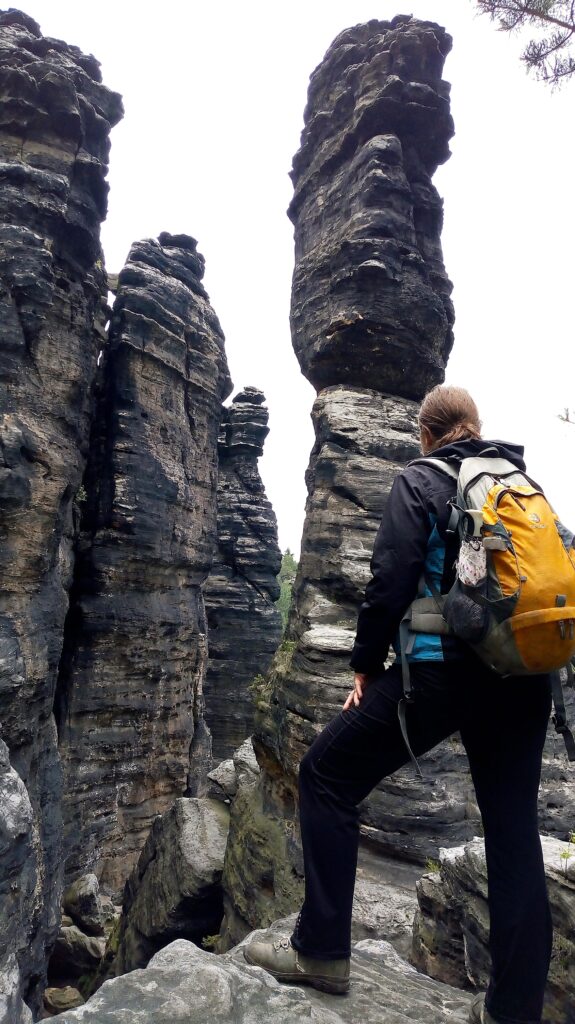
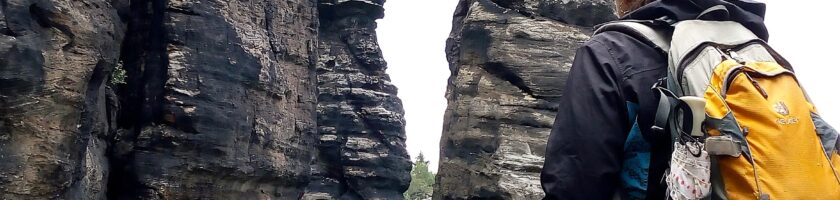
Sandstone pillars – iconic landforms of the Elbe Sandstone Mountains
by Alena Gessert (Slovakia)

The Hercules Pillars (Herkulessäulen) are striking sandstone rock towers located in the Saxon Switzerland National Park, eastern Germany, within the Elbe Sandstone Mountains. This region is built predominantly of Upper Cretaceous sandstones that are strongly jointed and horizontally bedded. Long-term denudation, selective weathering, and erosion along fracture systems have led to the separation of narrow rock pillars from the original sandstone plateau. Frost weathering, rainfall infiltration, and gravitational processes play a key role in shaping these landforms. More resistant sandstone layers form widened upper parts, while less resistant strata are preferentially removed, locally producing rock-mushroom morphologies. The Hercules Pillars represent an advanced stage of sandstone landscape dissection and are characteristic features of sandstone “rock cities,” illustrating the effectiveness of differential erosion in temperate climatic conditions.

Call for Grants for the 5th DENUCHANGE IAG Working Group Workshop (Naxos Island, Greece, 6–9 October 2026)

The International Association of Geomorphologists (IAG) announces the offering of 1 travel grant of 450 € (four hundred and fifty Euros) to support the participation of one Young Geomorphologist* (excluding Greece) in the 5th IAG DENUCHANGE Workshop in Greece (Naxos Island, 6-9 October 2026) organized by the IAG Working Group on Denudation and Environmental Changes in Different Morphoclimatic Zones (DENUCHANGE).

The workshop aims to bring together geoscientists, to contribute to an advanced understanding of denudation processes, such as weathering, erosion and mass movements in both coastal and terrestrial environments, their drivers, rates, diversity and variability around the world, and to facilitate future collaborations.

The first two days are dedicated to oral & poster presentations, followed by two days of field trips exploring natural hazards, weathering processes, and coastal dynamics from inland Naxos to its coastline. A training session will be organized if there are at least seven young geomorphologists among the participants. Otherwise, the young geomorphologists will be integrated into the workshop activities, including oral presentations and the field trip.

During the workshop, the IAG Working Group “Virtual Field Trips in Geomorphology” will offer hands-on laboratories focused on Virtual Field Trips (VFTs). These interactive sessions will provide participants with practical experience in the design and application of VFTs for geomorphological research and education. Participants will also have the opportunity to use VR headsets to explore immersive examples of VFTs firsthand. The labs aim to foster active collaboration between members of the two Working Groups and are particularly highly recommended for early-career geomorphologists, offering opportunities for skill enhancement and the exchange of innovative ideas.

For further information on the 5th IAG DENUCHANGE Workshop, please visit: https://uoa-gr.github.io/denuchange/

Applications from candidates who already achieved one or more IAG grants totaling 500 euros or more in the past 3 years will not be eligible.

Candidates for IAG GRANTS are requested to submit the following files up to Monday 18 May 2026:

  • Application form (.doc / .pdf) ;
  • Short CV (maximum 2 pages long), including up to 10 papers related to the Workshop themes ;
  • Certificate of the highest degree achieved (with the date of achievement) ;
  • Abstract submitted or to be submitted to the Workshop.

Criteria to be proved by the CV and abstract submitted to the Workshop:

  1. Scientific content based on the abstract (relevance to the workshop, scientific value, clarity in terms of English and structure).
  2. Academic activities based on the CV (dissemination of scientific results, e.g., publications, conferences, additional community activities such as event organisation, editorial activities, outreach, etc.).

Files should be submitted to:

Anita Bernatek-Jakiel and Efthimios Karymbalis, IAG Training Officers
e-mail: iaggrants@gmail.com (e-mail subject: “DENUCHANGE 2026“)

The selection of candidates will be carried out by a Commission appointed by the IAG Executive Committee. For further information on the IAG Grants feel free to contact the IAG Training Officers.


Prof. Efthimios Karymbalis & Dr. Anita Bernatek-Jakiel
IAG Training Officers
karymba@hua.gr / anita.bernatek@uj.edu.pl

*Undergraduate or postgraduate – Masters/PhD students or scientists who have received their highest degree, i.e. BSc, MSc, or PhD, within the past seven years. Provided parental leave fell into that period, up to one year of parental leave time may be added per child, where appropriate.

Call for Grants for the II European Young Geomorphologists Meeting (Italy/Slovenia/Croatia, 25-27 June 2026)

The International Association of Geomorphologists (IAG) announces the offering of 1 travel grant of 400 euros (four hundred Euros) to support the participation of one Young Geomorphologist (except from Italy, Croatia, and Slovenia) in the II European Young Geomorphologists Meeting (II EYGM) (Italy, Slovenia, Croatia, 25–27 June 2026).

The event is organised by the Italian Young Geomorphologists’ Coordinators of AIGeo, the Young Geomorphologists of Croatia (YGC), and the Geomorphological Society of Slovenia. Its aim is to strengthen relations with geomorphological associations in neighbouring countries and, more broadly, to promote cooperation among young geomorphologists from Europe and beyond. It seeks to foster scientific exchange, the sharing of research experiences, and the creation of an international network of early-career researchers in geomorphology.

The event begins with a day dedicated to participant introductions, research presentations, and an excursion around Ogulin (Croatia), concluding with an evening session on the geological and geomorphological setting of the region. The second day focuses on visits to key karst and canyon sites across Croatia and Slovenia before the group settles in Trieste (Italy). The final day is devoted to coastal geomorphology and coastal cliff retreat. The IAG grant holder will be granted free admission to the event.

More info on the event may be found on the following webpage: https://www.aigeo.it/ii-european-young-geomorphologists-meeting-ii-eygm-italy-croatia-slovenia-25-27-june-2026/

Applications from candidates who already achieved one or more IAG grants totalling 500 euros or more in the past 3 years will not be eligible.

Candidates for IAG GRANTS are requested to submit the following files by Monday 23 February 2026:

  • Application form (.doc / .pdf) ;
  • Short CV (maximum 2 pages long), including no more than 10 papers ;
  • Certificate of the highest degree achieved (with the date of achievement) ;
  • Abstract submitted to the Meeting.

Criteria to be proved by the CV and abstract submitted to the event:

  1. Scientific content based on the abstract (relevance to the meeting, scientific value, clarity in terms of English and structure).
  2. Academic activities based on the CV (dissemination of scientific results, e.g., publications, conferences, additional community activities such as event organisation, editorial activities, outreach, etc.).

Files should be submitted to:

Anita Bernatek-Jakiel and Efthimios Karymbalis, IAG Training Officers
e-mail: iaggrants@gmail.com (e-mail subject: “II EYGM“)

The selection of candidates will be carried out by a Commission appointed by the IAG Executive Committee. For further information on the IAG Grants feel free to contact the IAG Training Officers.


Prof. Efthimios Karymbalis & Dr. Anita Bernatek-Jakiel
IAG Training Officers
karymba@hua.granita.bernatek@uj.edu.pl

*Undergraduate or postgraduate – Masters/PhD students or scientists who have received their highest degree, i.e. BSc, MSc, or PhD, within the past seven years. Provided parental leave fell into that period, up to one year of parental leave time may be added per child, where appropriate.

5th IAG DENUCHANGE Working Group Workshop (Naxos, Greece, 6-9 October 2026)

The IAG DENUCHANGE Working Group is pleased to announce the 5th IAG DENUCHANGE Workshop, which will be held in Naxos, Greece, on 6–9 October 2026. This workshop aims to provide a platform for the international geoscience community to discuss advances in the study of denudation processes, including weathering, erosion, and mass movements, in both terrestrial and coastal environments. Participants will explore the drivers, rates, diversity, and variability of these processes worldwide, while fostering collaborative research opportunities.

Detailed information about the workshop is available here: https://uoa-gr.github.io/denuchange/
Call for abstracts is open until 30 May 2026.

The IAG offers one travel grant of 450€ to help a Young Geomorphologist to attend the workshop. Deadline to apply is 18 May 2026 – more information here.

The study of denudation processes has long been a cornerstone of geomorphology, encompassing research from small-scale soil and rock weathering to large-scale landscape evolution. Over recent decades, increasing attention has been given to the complex interactions between natural processes and human activities that shape inland and coastal environments. Advances in this field have been driven by interdisciplinary approaches combining geomorphology, hydrology, ecology, and environmental management. Nevertheless, there remains a pressing need for integrated studies linking catchment dynamics with coastal evolution, as well as for practical solutions addressing land degradation, erosion, and climate-related hazards.

In this context, the IAG DENUCHANGE Workshop in Naxos offers a timely opportunity to review recent advances, discuss emerging challenges, and explore future directions in denudation research.

The workshop will include two days of oral presentations and poster sessions, followed by a two-day post-workshop field trip across Naxos Island. The field excursion will emphasize the continuum between catchment dynamics and coastal processes, focusing on land degradation, flash flood hazards, cliff retreat, dune erosion, and the implementation of Nature-based Solutions for climate adaptation.

In addition, and in collaboration with the IAG Working Group on Virtual Field Trips in Geomorphology, the workshop will host hands-on Virtual Field Trip laboratories during the first two days of the meeting. These interactive sessions will provide participants with practical experience in developing and applying Virtual Field Trips in geomorphological research and education. The labs are expected to foster active interaction and exchange between members of the two Working Groups and to be particularly attractive to early-career and young geomorphologists, enhancing skills development and cross-fertilization of ideas.