5th IAG DENUCHANGE Working Group Workshop (Naxos, Greece, 6-9 October 2026)
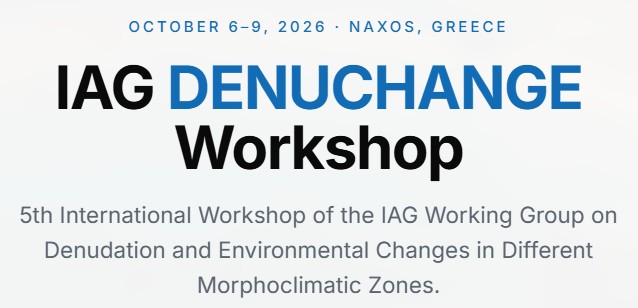
The IAG DENUCHANGE Working Group is pleased to announce the 5th IAG DENUCHANGE Workshop, which will be held in Naxos, Greece, on 6–9 October 2026. This workshop aims to provide a platform for the international geoscience community to discuss advances in the study of denudation processes, including weathering, erosion, and mass movements, in both terrestrial and coastal environments. Participants will explore the drivers, rates, diversity, and variability of these processes worldwide, while fostering collaborative research opportunities.
Detailed information about the workshop is available here: https://uoa-gr.github.io/denuchange/
Call for abstracts is open until 30 May 2026.
The IAG offers one travel grant of 450€ to help a Young Geomorphologist to attend the workshop. Deadline to apply is 18 May 2026 – more information here.
The study of denudation processes has long been a cornerstone of geomorphology, encompassing research from small-scale soil and rock weathering to large-scale landscape evolution. Over recent decades, increasing attention has been given to the complex interactions between natural processes and human activities that shape inland and coastal environments. Advances in this field have been driven by interdisciplinary approaches combining geomorphology, hydrology, ecology, and environmental management. Nevertheless, there remains a pressing need for integrated studies linking catchment dynamics with coastal evolution, as well as for practical solutions addressing land degradation, erosion, and climate-related hazards.
In this context, the IAG DENUCHANGE Workshop in Naxos offers a timely opportunity to review recent advances, discuss emerging challenges, and explore future directions in denudation research.
The workshop will include two days of oral presentations and poster sessions, followed by a two-day post-workshop field trip across Naxos Island. The field excursion will emphasize the continuum between catchment dynamics and coastal processes, focusing on land degradation, flash flood hazards, cliff retreat, dune erosion, and the implementation of Nature-based Solutions for climate adaptation.
In addition, and in collaboration with the IAG Working Group on Virtual Field Trips in Geomorphology, the workshop will host hands-on Virtual Field Trip laboratories during the first two days of the meeting. These interactive sessions will provide participants with practical experience in developing and applying Virtual Field Trips in geomorphological research and education. The labs are expected to foster active interaction and exchange between members of the two Working Groups and to be particularly attractive to early-career and young geomorphologists, enhancing skills development and cross-fertilization of ideas.