Call for Grants for the IX Argentine Congress of Quaternary and Geomorphology (Diamante, Entre Ríos, Argentina, 25–28 August 2026)
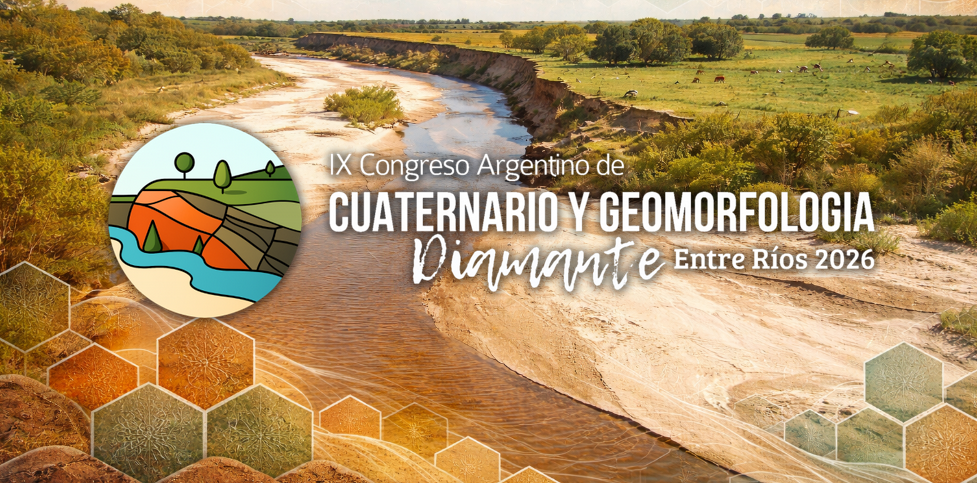 The International Association of Geomorphologists (IAG) announces the offering of 1 travel grant of 400 € (four hundred Euros) to support the participation of one Young Geomorphologist* from Latin America (excluding Argentina) in the IX Argentine Congress of Quaternary and Geomorphology (Diamante, Entre Ríos, 25–28 August 2026) organized by the Argentine Association of Quaternary and Geomorphology. The organizers will waive the registration fee for the IAG grant holder. The official language of Congress is Spanish. The Congress is open for Latin America community, Spanish-speaking and Brazilian.
The Argentine Congress of Quaternary and Geomorphology is organized every three years since 1999. It gathers professionals, researchers, and advanced undergraduate and graduate students in Geomorphology, Geology, Geophysics, Biology, Paleontology, and related fields from Argentina and other countries. The main goal is to present recent advances, exchange experiences, and discuss challenges related to Geomorphology, Neotectonics, Tectonic Geomorphology and Paleoseismicity, Geodiversity and Geomorphological Heritage, Sedimentology, Stratigraphy, Mass Wasting Processes, Paleolimnology, Geocryology, Paleoclimates, Geophysics, Geodesy, Geological Hazards, Geoarchaeology and Paleontology, Territorial Planning, Soils, Environmental Studies, and Geotechnics, among other topics.
The event will include oral and poster presentations, keynote lectures, pre-congress courses, and field excursions to continental inland regions. These activities will provide participants with the opportunity to explore sites featuring exceptionally well-preserved fluvial terrace exposures.
The conference programme includes also activities designed for young geomorphologists. A lecture will be delivered on geomorphological methods and practical applications of drones in geomorphology and geological surveying. During the field excursion, participants will be introduced to geospatial techniques such as ground-penetrating radar, GNSS, and drone-based photogrammetry, applied to the Quaternary stratigraphic record. In addition, a pre-conference course on scientific writing will be offered. During a mid-conference field trip, a case study will be presented on a major landslide that impacted the host city in 2018.
For further information on the IX Argentine Congress, please visit:
Website: https://aacg.ar/9cacyg2026/#ld-1772030297194-25380378-e4a9
Applications from candidates who already achieved one or more IAG grants totaling 500 euros or more in the past 3 years will not be eligible.
Candidates for IAG GRANTS are requested to submit the following files up to Monday 15 June 2026:
– Application form in English (doc / pdf )
– Short CV (maximum 2 pages long), including up to 10 papers related to the Congress themes – in English
– Certificate of the highest degree achieved (with the date of achievement).
– Abstract submitted or to be submitted to the Congress – in Spanish.
Criteria to be proved by the CV and abstract submitted to the Congress:
1. Scientific content based on the abstract (relevance to the Congress theme, scientific value, clarity in terms of Spanish and structure).
2. Academic activities based on the CV (dissemination of scientific results, e.g., publications, conferences, additional community activities such as event organisation, editorial activities, outreach, etc.).
Files should be submitted to:
Anita Bernatek-Jakiel and Efthimios Karymbalis, IAG Training Officers
e-mail: iaggrants@gmail.com (e-mail subject: “Argentine Congress 2026”)
The selection of candidates will be carried out by a Commission appointed by the IAG Executive Committee. For further information on the IAG Grants feel free to contact the IAG Training Officers.
Prof. Efthimios Karymbalis & Dr. Anita Bernatek-Jakiel
IAG Training Officers
karymba@hua.gr / anita.bernatek@uj.edu.pl
*Undergraduate or postgraduate – Masters/PhD students or scientists who have received their highest degree, i.e. BSc, MSc, or PhD, within the past seven years. Provided parental leave fell into that period, up to one year of parental leave time may be added per child, where appropriate.